Seasonal ag truckers from Mexico face same English-language rules, DOL says
A question from a Texas truck driver has produced a clear answer from the U.S. Department of Labor: H-2A visa holders who operate commercial motor vehicles are covered by federal English-language proficiency requirements.
The trucker, who asked to remain anonymous, contacted FreightWaves after reading an article about a Canadian truck driver arrested in New Mexico for alleged cabotage violations. He wanted to know whether the federal government’s English-language enforcement policy also applies to H-2A workers who drive trucks using Mexican commercial licenses.
“Many Mexican CDL drivers are contracted via the federal H-2A program here in Texas and many other states,” the driver wrote.
The Labor Department said its guidance applies broadly.
“The guidance applies to any person operating a commercial motor vehicle who is hired and employed under a temporary or permanent labor certification granted by DOL, including H-2A,” a department spokesperson told FreightWaves.
Employers must apply the English-language proficiency requirement in a nondiscriminatory manner, the spokesperson said.
The response clarifies the employer’s obligations in the H-2A labor-certification process. It does not create a separate standard for foreign agricultural workers.
Under federal regulations, a driver operating a commercial motor vehicle in interstate commerce must be able to read and speak English well enough to communicate with the public, understand highway signs and signals, respond to official questions and make entries on reports and records.
The Federal Motor Carrier Safety Administration’s current roadside policy applies to all drivers operating commercial motor vehicles in interstate commerce in the U.S. Drivers who fail the agency’s English-language assessment can be placed out of service, except for a limited enforcement treatment covering trips that remain within U.S.-Mexico border commercial zones.
FMCSA and the Texas Department of Public Safety did not respond to FreightWaves’ questions about whether either agency tracks roadside English-language violations or out-of-service orders involving H-2A drivers.
Labor Department data shows the issue potentially reaches thousands of seasonal jobs, although the public records do not identify workers’ nationalities, licenses or whether every certified position was ultimately filled.
From Oct. 1, 2025, through June 30, 2026, the department’s Office of Foreign Labor Certification certified about 470 H-2A applications covering 3,320 jobs in the broad Transportation and Material Moving Occupations category, excluding hand packers.
A FreightWaves analysis of the department’s disclosure file found that 310 of those applications, covering 2,609 jobs, were classified specifically as heavy and tractor-trailer truck drivers or light truck drivers. That represents nearly 79% of the 3,320 transportation-related positions cited by DOL.
The remaining positions included shuttle drivers and chauffeurs, commercial pilots, aircraft service attendants, bus drivers and several other transportation occupations. That distinction matters because DOL described the 3,320 jobs as occupations “generally associated” with operating commercial motor vehicles, not as a precise count of H-2A truck drivers.
Texas led the country with 515 certified H-2A truck-driver jobs across 40 applications, followed by Louisiana with 448 jobs and New Mexico with 272. Iowa had 140, Arizona 112 and California 111.
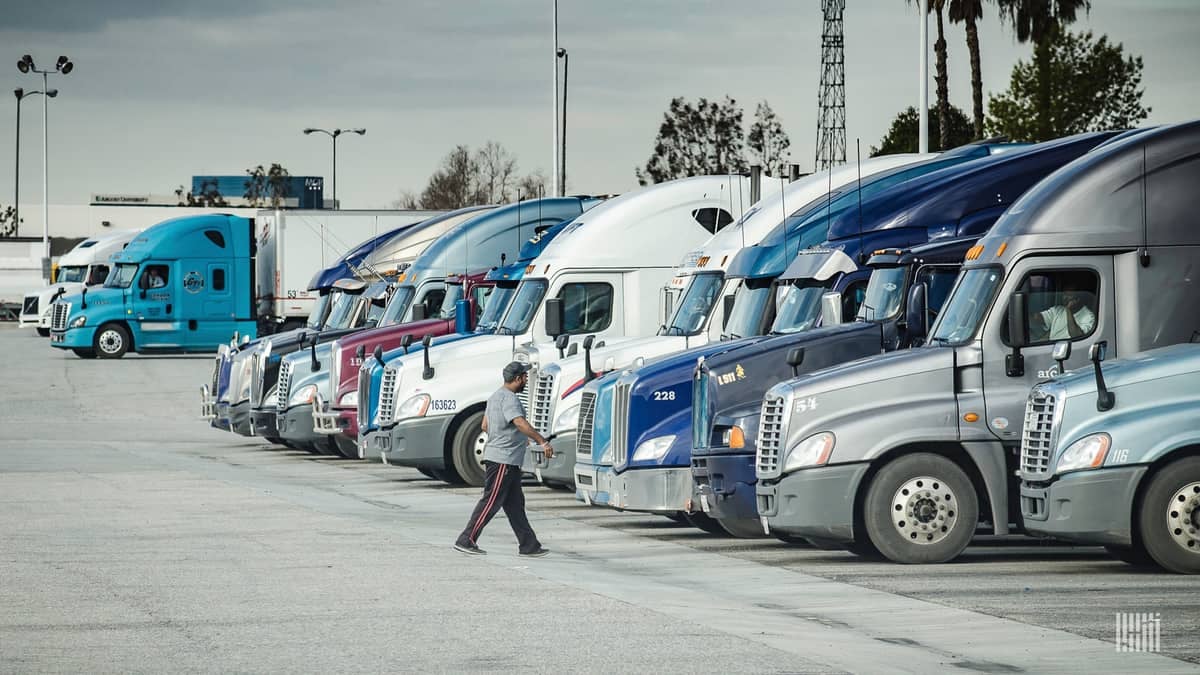
Texas led the country with 515 certified H-2A truck-driver jobs across 40 applications, followed by Louisiana with 448 jobs and New Mexico with 272. Iowa had 140, Arizona 112 and California 111. (Photo: Jim Allen/FreightWaves)
The certifications show where employers received authorization to hire temporary foreign workers. They do not show how many workers received visas, entered the U.S., drove a commercial vehicle or faced an English-language inspection.
The data also does not show how many held Mexico’s federal commercial driver’s license. The U.S. recognizes Mexico’s Licencia Federal de Conductor for commercial operations, but not commercial licenses issued by individual Mexican states.
A qualified Mexican driver using the federally issued license does not need a state-issued U.S. CDL solely because the driver works for a U.S. company.
DOL says major compliance problems have not emerged
The Labor Department announced its English-language guidance May 14 and began applying it prospectively to filings June 15.
Job orders and applications for temporary or permanent labor certification must state an English-language proficiency standard consistent with federal requirements when a position requires the worker to operate a commercial motor vehicle.
If an employer omits the requirement, DOL can issue a notice of deficiency and pause the application until the filing is corrected. FMCSA remains responsible for roadside screening and enforcement, while the State Department conducts its own proficiency assessments during visa interviews.
DOL said it has not found significant compliance problems since implementation began.
“Many employers already disclosed ELP requirements on agricultural job orders previously,” the department spokesperson said, adding that employers have not been required to amend applications or job orders “in any significant manner.”
The Office of Foreign Labor Certification has received a moderate number of requests for more frequently asked questions or concerns about how the May guidance should be implemented, according to DOL.
The available federal guidance indicates that H-2A status does not exempt a commercial driver from the English-language rule. What remains unclear is how often H-2A drivers are encountering the policy at roadside and how frequently failures result in out-of-service orders, because neither FMCSA nor Texas DPS supplied visa-specific enforcement data.
Why it matters:Agricultural employers received certification for at least 2,609 H-2A truck-driver jobs in the first nine months of fiscal 2026, and those workers face the same federal English-language standard as other interstate commercial drivers.