

Diesel Just Hit $5 a Gallon and Linehaul Rates Have Not Moved Much. Here Is How to Fix That in Your Very Next Negotiation With a Broker.
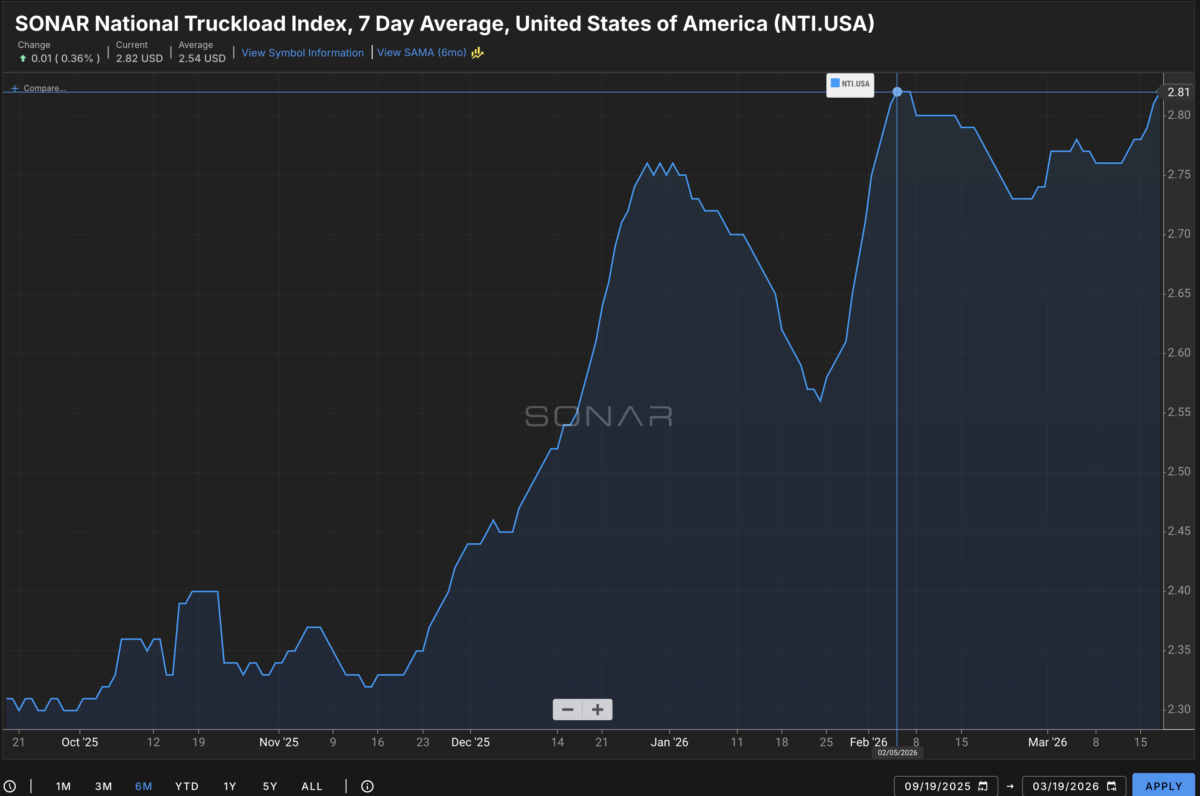
One month ago the national average for diesel was $3.65 a gallon. As of this week, it is over $5.00. According to AAA, that is a 38% increase in roughly 30 days — the fastest one-month fuel price spike the trucking industry has experienced in years, driven by U.S. and Israeli airstrikes against Iran that have choked off Strait of Hormuz oil flows. And according to DAT Freight & Analytics, the national average spot linehaul van rate has barely moved in response. The fuel surcharge embedded in the all-in spot rate that carriers are accepting today was calculated before the spike. Carriers are moving freight at rates that were priced for $3.65 diesel and paying for fuel at $5.04.
That math does not work. The only reason it keeps happening is that too many carriers walk into a broker negotiation without a plan, let the broker set the frame, and accept the first number because they do not know what to say after “that’s all I have in the load.”
This article is the plan. A full breakdown of how spot rate negotiations actually work, why brokers say what they say, what the carrier should know before picking up the phone, and exactly how to respond to every deflection a broker will throw at you — including that one.

Understanding the Spot Rate Structure Before You Call
Before getting into negotiation tactics, you have to understand what you are negotiating over. In the spot market, the rate a broker quotes is an all-in number. It includes linehaul and fuel together as a single figure. There is no separate fuel surcharge line item the way there is in contract freight. The broker receives a load from a shipper at an all-in price, takes their margin, and offers the carrier the rest. The number they quote you reflects what they want to pay — not necessarily what the load is worth, and not what accounts for current fuel costs.
This structure is critical to understand because it means the fuel component of your rate is negotiable every single time. When diesel was $3.65, the fuel component embedded in a typical spot rate was calibrated to that price. Now that diesel is $5.04, the fuel component embedded in that same rate is wrong — and the broker knows it. The question is whether the carrier is going to let that go or whether they are going to negotiate it back.
DAT Chief of Analytics Ken Adamo said it directly in the most recent DAT market release: “Without fuel hedging, contract pricing, or surcharges, carriers will need to negotiate higher spot rates now to compensate for higher pump prices. Otherwise, more carrier exits are likely.” That is not a soft suggestion. It is a statement of math. And the math starts with knowing your numbers before the call.
Know Your Number Before You Dial
The single biggest reason carriers lose broker negotiations before they begin is that they call without knowing their minimum acceptable rate. Not a gut feel. Not what they got last week. An actual, calculated floor below which the load does not cover operating costs.
Here is the calculation every carrier should be running before every negotiation right now.
Start with your total miles for the lane — not just loaded miles. This matters more than most carriers realize. If you are driving 150 empty miles to pick up a 500-mile load, your true fuel cost is calculated on 650 miles, not 500. A carrier who only counts loaded fuel cost is undercutting their own floor before they even dial. Know your deadhead. Factor it in.
Now apply your fuel cost per mile. Most loaded Class 8 tractors run between 6 and 7 miles per gallon depending on load weight, terrain, and equipment spec. Use your actual number. At 6.5 MPG and $5.04 diesel, you are spending $0.775 per mile in fuel. At the same MPG and $3.65 diesel, it was $0.562 per mile. That is a $0.213 per mile increase on every mile you drive — loaded or empty. On a 500-mile loaded run with 100 miles of deadhead, that is an additional $127.80 in fuel cost versus what last month’s rate was built to cover.
Now add your other cost-per-mile figures. ATRI’s 2025 benchmarking report puts the 2024 industry average cost of operating a truck at $2.26 per mile all-in. That figure was calculated at 2024 average diesel prices, which ran near $3.65 per gallon for much of the year. With diesel at $5.04 today, that $2.26 baseline is no longer accurate — your fuel line item alone has increased by roughly $0.21 per mile. Your true current all-in cost is closer to $2.47 per mile before any margin, and that is the industry average. Your specific number will vary based on equipment age, financing terms, insurance costs, and how many empty miles you are running. If you do not know your cost per mile, you cannot negotiate. You are just guessing, and brokers know when carriers are guessing.
Once you have your cost per mile, add a real margin — not a token one. The truckload sector posted an average operating deficit of -2.3% in 2024 even before this fuel spike, according to ATRI. That means the industry average carrier was already losing money. A dime above cost is not a margin — it is a breakdown or a slow-pay shipper away from a loss. Think in terms of what it actually takes to absorb a tire blowout, a detention event that eats four hours, or a deadhead run that comes back empty. A meaningful margin in this environment is at minimum $0.20 to $0.30 above your true all-in cost. Know what that number is. That is your floor.
That floor is what you walk into every negotiation with. It is not negotiable on your end. Everything above it is.
What the Broker Is Actually Doing on the Other End of the Phone
Understanding broker behavior is not about being cynical. It is about knowing what you are dealing with so you can navigate it effectively.
The broker received the load from a shipper at a fixed price — call it the shipper buy rate. They have a target margin they need to hit to cover their own costs and stay profitable. According to data, average gross margins for small-to-mid-sized brokerages have been running below 15%, with many operating in the 9% to 12% range. The brokerage business is not a license to print money right now. That matters because it means some brokers genuinely are closer to their floor than the carrier assumes.
But some are not. And the carrier who never pushes back never finds out which situation they are in.
When a broker says “that’s all I have in the load,” understand what that sentence actually means. It means one of three things. First, it may be true — they are at or near their buy rate and genuinely cannot move. Second, it may be a negotiating posture — they have room and they are testing whether you will accept the lower number without pushing back. Third, it may be partially true — they have some room but not as much as you want, and they need you to meet them somewhere in the middle.
The carrier who accepts the first number every time never finds out which of those three situations they are actually in. The carrier who responds with a calm, data-driven counter finds out quickly.
Here is the key nuance: push back selectively, not reflexively. Every broker call is not the same negotiation. Loads with tight appointment windows, difficult commodities, unusual dimensions, or origins with low truck availability tend to have more room than a straightforward van load on a high-volume corridor. If a broker calls you rather than you calling in on a posting, there is usually urgency behind it — and urgency means leverage. Read the load before you read the rate. Then negotiate accordingly.
Brokers negotiate for a living. Most carriers do not. That asymmetry is the gap this article is designed to close.
The Negotiation — From First Call to Confirmation
Here is how a fuel-informed spot rate negotiation should go from start to finish.
Before you call, look up the lane on SONAR Blue to Blue or your load board. Note the market rate for that origin-destination pair over the last 7 to 14 days. This is your anchor. The broker will have it too. You want to be working from the same data, not from instinct.
When the broker calls you — or when you call in — do not accept or reject the first number immediately. Ask questions first. Find out the load details: miles, weight, commodity, any accessorials, pickup and delivery appointment windows. You need the full picture before you know whether the rate makes sense. And you need to know the total mileage — loaded plus your deadhead to the pickup — before your cost math is accurate.
When the broker gives you a number, acknowledge it without accepting or rejecting it. Something like: “I’ve got it. Let me look at the lane for a second.” That pause signals that you are doing your homework, not just reacting. It also gives you a moment to confirm your cost math against the number on the table.
If the number is below your floor, come back with a specific counter — not a range, not a question, a number. “I need $2.65 to make this work. Fuel is at $5.04 right now and my all-in cost on this lane including my deadhead is $2.45. I can move at $2.65.” The specificity matters. When you name a number tied to a reason, you change the nature of the conversation. The broker is no longer negotiating against a carrier who wants more money. They are negotiating against a carrier who knows their cost structure and is making a business decision. That is a different conversation.
When the broker says “that’s all I have in the load”, do not fold. Respond with something like this: “I understand. I’m not trying to squeeze you — I’m telling you what diesel is doing to my cost right now. Fuel is $1.39 higher than it was six weeks ago. That’s real money on this lane. If you’ve genuinely got no room, I get it, but if there’s anything in there I’d rather find it now and get loaded than both of us waste time.”
That response does three things. It acknowledges the broker’s position without surrendering yours. It makes the fuel argument in plain dollars rather than abstract percentages. And it gives the broker a graceful path to coming back with a better number if they have one. Many will.
If they hold firm, ask a follow-up: “Is there anything on the accessorial side? Is there a TONU if the shipper cancels? Is there a detention policy on this load?” Brokers sometimes have flexibility on accessorials even when the linehaul is locked. A solid detention rate, a layover provision, or a cancellation fee can add real value to a load even when the base rate does not move. It is not a substitute for a fair linehaul rate, but it is money, and it belongs in the conversation.
If the load genuinely does not work at any number they can offer, say so clearly and professionally. “I appreciate the call. I can’t make this work at that fuel cost. If you get something better or the rate moves, I’m in.” Then move to the next option. The worst thing you can do is accept a load at a rate that does not cover your costs because you felt uncomfortable saying no. That is not persistence. That is how carriers go out of business.
The Fuel Argument in Specific Numbers
Brokers respond to specifics. The carrier who says “fuel is too high” is easy to dismiss. The carrier who says “diesel is $5.04 today versus $3.65 four weeks ago — that’s a $1.39 increase, and at my fuel economy that’s an extra $0.21 per mile on this lane including my deadhead” is making a documented business case. It is much harder to brush off.
Here is how to run those numbers in real time during a negotiation.
Know your miles per gallon. Most loaded Class 8 trucks run between 6 and 7 miles per gallon depending on load weight, terrain, and truck spec. Use your actual number. At 6.5 MPG and $5.04 diesel, you are spending $0.775 per mile on fuel. At the same MPG and $3.65 diesel, it was $0.562 per mile. The difference is $0.213 per mile on every mile driven. On a 500-mile load with 100 miles of deadhead — 600 total miles — that is $127.80 in additional fuel cost compared to what last month’s rate was built to cover.
That number is not an opinion. It is arithmetic. When you put a specific dollar figure on the table, it anchors the conversation in reality. It also demonstrates that you are a businessperson who understands your own costs, which changes how a broker engages with you over time.
Brokers remember carriers who negotiate with data. They also remember the ones who take whatever is offered without question — and those carriers tend to get offered less.
Knowing When to Walk
The discipline to walk away from a bad load is the most underrated skill in carrier negotiation. It is also the most directly tied to business survival.
The market right now is not uniform. Flatbed is running strong. Reefer has held firm. Dry van has been more competitive. Regional variations are significant — the carrier who knows the load-to-truck ratio on their home market lanes has information the carrier staring at a national average does not. Pull your lane data before every call. Know which lanes are tight and which are long. That knowledge is leverage.
If a broker consistently comes in below your cost floor on a particular lane, that is market information. It means either the lane is structurally underpriced for your cost structure, the load type requires a different approach, or the broker is not the right fit for your business. None of those conclusions are available to a carrier who accepts whatever they are offered.
Walk away from loads that do not cover costs. Do it consistently. Do it professionally. The brokers who value your service and your reliability will come back with better numbers. The ones who do not were never going to pay you fairly anyway.
One important caveat: walking away from a load costs you that load’s revenue for the day. If you are walking on a load in a lane where no better option exists, that is not a win — it is a clean loss. The walk-away strategy only works if you are actively developing alternatives: building a direct shipper list, working multiple load boards, knowing which brokers cover your lanes at better rates. Walk away power comes from having somewhere else to go. If your only option is this broker and this load, that is not a negotiation — it is a rate acceptance with extra steps. The longer-term answer to that situation is the direct shipper work covered elsewhere on this platform.
The Longer Game
Negotiation is not just about any individual load. It is about the pattern you establish with every broker you work with regularly.
Carriers who consistently negotiate from cost data — who call back with specific numbers, who do not fold at the first pushback — those carriers get taken more seriously in the next call. Brokers talk within their companies. If you are known as a carrier who does their homework and holds their position, you are also known as a carrier whose capacity is worth paying for. That reputation compounds over time.
The carriers who are going to come out of the current fuel environment in the strongest position are not necessarily the ones with the newest trucks or the best fuel economy, though those things matter. They are the ones who understand that a negotiation is a conversation between two businesspeople, not a favor the broker is doing by calling. They have a cost floor that includes deadhead. They know the lane rate. They make a specific counter. They respond to pushback with data. And they know when to walk.
The broker saying “that’s all I have in the load” is not the end of a negotiation. It is the beginning of one. The carrier who knows that — and responds accordingly — keeps more of their own money. Right now, with diesel at five dollars a gallon and linehaul rates where they are, that difference is not incidental. It is the margin between a business that survives this fuel spike and one that does not.
The post Diesel Just Hit $5 a Gallon and Linehaul Rates Have Not Moved Much. Here Is How to Fix That in Your Very Next Negotiation With a Broker. appeared first on FreightWaves.